In Parshat Bo, we learn the laws that applied to the first
Pesach which took place in
In Shmot 12:21 we read: “Moshe called to all the elders of
said to them, “Draw out (mishchu) and take (ukchu) for yourselves lambs
according to your families and slaughter the Pesach offering.”
Why does it have to say “draw out” and “take”?
Ramban’s explanation is that both words are needed to explain
the full physical process of how they got the lamb.
According to Ramban, first they had to go all of the way to
out) and then they had to bring it home (take).
Rashi brings the Mechilta to explain why both words are needed
since each one refers to something else: If you have a sheep, then use it (draw
out), if you don’t have a sheep then go and buy one (take).
The Mechilta also brings a second, more spiritual
explanation: Leave your idol worship (draw out) and take for yourselves (take)
a sheep which is a god of
and sacrifice it for the Pesach offering.
Before moving on, one must do Tshuva (repent) for what we
have done wrong in the past and commit to not repeating that behavior again.
Rabbi Yaakov Zvi Mecklenberg, HaKtav v’Hakabla states:
The Israelites themselves were responsible in part for
deferring their own redemption. First they had to be purified and show by some
outstanding act of self-sacrifice that they had repented of their ways. If they
were willing to place their lives in danger in order to carry out the wishes of
God then, that would be a true token of their love for Him. Consequently, God
commanded them to slay the Egyptian god under conditions of the widest
publicity. First they had to procure the lamb, lead it through the streets
without fear of Egyptian reaction, second, to slaughter it family by family, in
groups and finally they had to sprinkle its blood on the doorpost of every
Egyptian passer-by to see, braving the vengeance of their former persecutors.
Their fulfillment of every detail of this rite would be a proof of their
complete faith in God. In the words of the Sages, the blood would be taken “to
you” and not to others.
Once B’nai Yisrael completed this Tshuva process, they were
ready to observe the mitzvot.
Converts to Judaism and Baalei Tshuva (newly observant Jews)
face the difficult challenge of putting their pasts behind them and committing
themselves to become religious Jews. Their challenges are just as difficult as
the challenges that B’nai Yisrael faced when the left
give them as much help and support as possible to help them on their spiritual
journeys.
Please consider supporting Torat Reva Yerushalayim before the end of 2013!
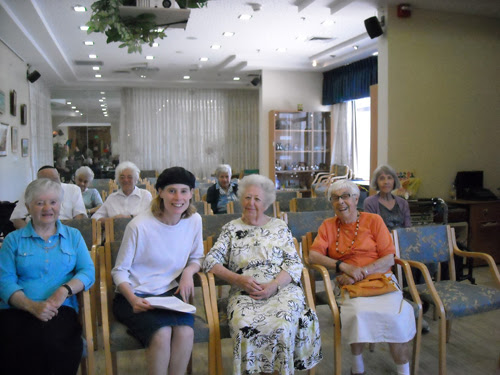 With your help we can continue to provide Torah study classes for students of all ages and backgrounds including Jerusalem’s elderly population in senior centers, nursing homes and assisted living residences, people with special needs in group homes and “Mommy and Me” classes for mothers and their babies.
Our goal is to continue to expand our programming throughout Jerusalem!
The following is a list of suggested giving opportunities:
With your help we can continue to provide Torah study classes for students of all ages and backgrounds including Jerusalem’s elderly population in senior centers, nursing homes and assisted living residences, people with special needs in group homes and “Mommy and Me” classes for mothers and their babies.
Our goal is to continue to expand our programming throughout Jerusalem!
The following is a list of suggested giving opportunities:
Weekly class for a year
$2500
Weekly class for a semester
$1250
Yom Iyun- Day of Dedicated Learning
$1000
Monthly class for a year
$900
Monthly class for a semester
$500
Weekly class for a month
$360
Tehillim (Psalms) at the Kotel (Western Wall)
$180
One Class
$90
Parsha Points Weekly Newsletter
$54
Torat Reva Dedication Card
$36
| Weekly class for a year | $2500 |
| Weekly class for a semester | $1250 |
| Yom Iyun- Day of Dedicated Learning | $1000 |
| Monthly class for a year | $900 |
| Monthly class for a semester | $500 |
| Weekly class for a month | $360 |
| Tehillim (Psalms) at the Kotel (Western Wall) | $180 |
| One Class | $90 |
| Parsha Points Weekly Newsletter | $54 |
| Torat Reva Dedication Card | $36 |